Toy Store Observation

Earlier today, I took a trip to Target and decided to take a walk through the toy section. Since the holidays are coming, the aisles were pretty busy and I noticed that the only people shopping for toys were women, all of which were probably mothers. There was a very clear divide between the boys and the girl’s section. When looking at the toy section from afar, the girl’s section immediately stood out for me with its array of bright pink colors. The boy’s section, on the other hand, was less bright and consisted of more neutral, dark colors. When walking through the girl’s section, I found that there was an entire wall dedicated to all things Barbie. The Barbies themselves weren’t very diverse and it was hard for me to find a brown Barbie, in total I counted about nine different Barbies of color. Across from the Barbies was a section for baby dolls, it amazed me that the toy baby section is pretty similar to what I saw in the actual baby aisle. You can find anything here from toy diapers to baby clothes and even pretend baby food. As I continued through the girl’s section, I found toys that promoted female gender roles such as pretend kitchen sets, makeup sets, and jewelry kits. It was difficult to find anything in this aisle that wasn’t pink or purple, colors that were considered masculine such as green and blue were very limited.

The boy’s aisle, in all its darkness, gave off a very different vibe from the aisle next door. The toys in this section were examples of masculinity such as pretend weapons, buffed up action figures, and sports supplies. I found it interesting that the sports supplies were located in the boy’s section and not the girl’s section, the sports supplies that targeted girls were pink, such as a pink soccer ball. It was also impossible to find pink or purple in this aisle, as those would be considered feminine colors and no parent would be caught dead buying their son something pink. The toys in both sections have packaging that showed children playing with the toys. The boy’s section, like the girls, would only show boys on the packaging, giving the message that these toys were specifically meant for one gender and not the other. The gender-neutral aisle consisted of things like Legos, slime, and play-dough. Even though this aisle was the most inclusive of all genders, there were still subtle messages that targeted one gender and not the other. For example, the Legos for boys usually involved themes like Star Wars and were also much more difficult to build. The Legos for girls, on the other hand, were usually pretend houses and were much easier to build.
My observation of the Target toy section allowed me to gain a closer understanding as to how society rarely allows the two genders to overlap. The clear divide between the aisles gave me the impression that when it comes to children and gender, you must shop in the aisle assigned at birth, there is no overlapping, there is no inclusion.
On Becoming Female

Many defining moments in my childhood shaped me into the person I am today. Donna Eder explains that for many girls, middle school is an important time in which individuals develop a more precise sexual identity. In this excerpt, Eder presents an evaluation of the middle school experience and the social lessons that are taught to girls from a young age.

My first day of middle school, at the time, was the most important day of my life to date. Middle school was going to be a fresh start for me, I was so tired of being bullied for my appearance and I was willing to do anything to prevent this from happening again. To avoid being made fun of, I changed my appearance completely in an attempt to be more beautiful. I started to wear heavy eyeliner, shorter shorts, low cut shirts, and anything that amplified my features and made me look “sexy.” I started to notice a difference in the way people, specifically boys, treated me. They began to give me more attention and at the time, this was the best thing that could’ve happened to me. I realized that it was my appearance that had gotten be this far, the person I was beneath the surface had nothing to do with it. Attractiveness continued to be a recurring theme throughout middle school, the most popular girls at the school were also the prettiest. They were the ones that were never made fun of, they seemed to have some sort of invincibility against any form of ridicule. Although I had done everything I could to minimize my flaws, my old bullies always found something to make fun of, usually it was the color of my skin. Like Eder mentions in this excerpt, I began to spend so much of my time worrying about my appearance that I failed to develop a sense of self that was strong and confident. It’s taken me some time to see past the surface and understand that beauty is simply a social construct.

On Becoming Male

Having been born a female, it’s difficult for me to relate directly to the lessons that Henslin refers to in his excerpt On Becoming Male. For the most part, the households I grew up in were mostly female, except for my cousin David who was my best friend growing up. Like I’ve mentioned before, and as Henslin demonstrates in this excerpt, the rules for David were different from my own.

David was allowed to roam free and play in the dirt, he was able to get away with certain things that I would have never been permissible for me. David’s upbringing, however, was different because he was surrounded by so many women. Instead of leaving him out of things that were traditionally female activities, my other cousins and I tended to include him. He would play “kitchen” with us just as much as we would participate in Nerf gun war with him. As we grew older, the social divide that stood between us also grew. He was now expected to become a man, just as I was expected to become a woman. This meant that he could no longer play kitchen and that I would have to put down the Nerf guns. David was taught how to properly mow a lawn, he was taught how to replace a tire, and most importantly, he was taught how to repress his feelings. The last time I saw my cousin cry was when he was ten years old, he was crying because he fell off his scooter and had cut himself pretty badly. He was told to put some rubbing alcohol on it and suck it up, had I been in his position I would’ve received different treatment. The differences between us are very clear, I have been taught that it’s okay, as a woman, to not only feel things deeply but to share these feelings with other people. At some point, David must have realized what was expected of him, he must’ve realized that for others to see him as a man, he would have to let go of everything that he had learned in a female household.

Lessons On Gender

When I was a little person, my parents shaved my head because they thought it would give me good hair. For a while, I looked like a boy. When I was old enough to understand the concept of gender, around the age of four, I would look at old pictures of myself and ask my mom if I had a brother. My mom tells me that when I was a little person, I liked to wear boy clothes, I would cry hysterically if she tried putting me in a dress. I was a non-conforming child and although I enjoyed playing with Barbie’s, I wore cargo shorts and played with Hot Wheels from time to time.

Once I got older, I started to like dresses, there was one specific dress that my mom had to throw away because I refused to take it off. The thing about my parents was that they always allowed me to roam free and express myself in whatever ways I wanted to. As I got older, things started to change. I was told that I would have to learn how to cook, my mom insisted that if I didn’t learn, I couldn’t get married. I was taught how to properly clean a house, everything from window cleaning to toilet scrubbing was crucial for me to learn. When I would wash the dishes, I would watch my cousin David ride his bike outside, I envied him because all he ever had to do was take out the trash. The lessons continued, once I was old enough to understand sex, my mother told me that I should wait until marriage so that I was “clean” and “holy” for my husband. I was told that when going to church, it was only appropriate for me to wear knee-length dresses, jeans were only acceptable if they were paired with a pretty blouse. When you’re a little person, it’s easy to roam free. As a child, I had yet to be contaminated by society’s gender norms, the lessons pile up as you get older. At one point in my life, I let these norms define me. It’s important to realize that it’s all socially constructed, I choose to not be confined by it.

Chapter 11: Democratizing beauty for all women: A worthy goal?

As a young girl, I never felt beautiful, even though I lived in a society that encouraged all women to feel beautiful. Today, social movements such as the body positivity movement have pushed for the inclusion of plus-sized women in the fashion industry. These movements are an attempt to encourage women of all shapes, sizes, and colors to feel beautiful. The beauty standards I grew up with were very different and even damaging to my self-esteem. Although today we see more inclusion in the beauty industry, the common ideal of what is considered beautiful has yet to change.

In the year 2009, Angelina Jolie was named the most beautiful woman in the world. The three most notable things about Jolie were her lips, her body, and her eyes. Jolie’s lips were probably her most notable feature as there was a trend in which everyone wanted to have “Angelina Jolie Lips.” With the rise of this trend, I began to overline my lips with lipstick in an attempt to make them look bigger. I began wearing push-up bras that were made to double the size of my breasts. I started to wear heavy eyeliner as an attempt to give myself the “sultry” look that Jolie had. My morning routine went from being twenty minutes long to two hours long. I began to spend so much time, money, and effort all in the name of beauty. I am able now to recognize the media’s agenda, beauty ideals are set in place to sell me products, whether that be makeup, plastic surgery, or even clothing. Although the beauty industry encouraged me to feel beautiful, it also told me that there was only one way to be beautiful, this idea had nothing to do with inclusion. I began to bury myself underneath layers of makeup to the point where I didn’t recognize myself without it. For this reason, I wish I would’ve rejected the invitation to strive for beauty. Had I been okay with who I was, I would’ve saved myself a great deal of pain and self-esteem issues.

Chapter 7: Toys/Gender, Sex and Sexuality

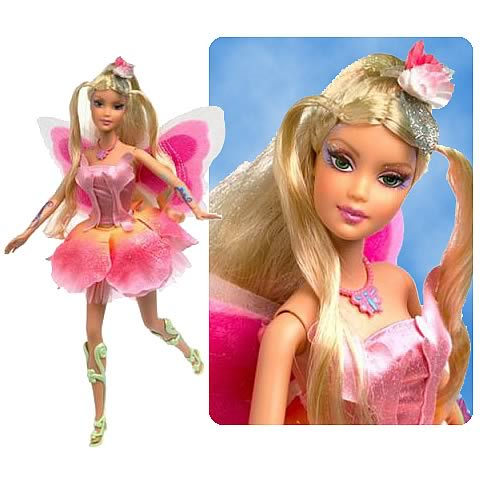
Barbie Fairytopia Elina Doll

The first significant toy I remember having as a child was a Barbie Fairytopia doll that was gifted to me on my seventh birthday. I had such a strong connection with this Barbie that I gave her a name and had made it a point to take her with me everywhere I went. The doll’s face was plastered with makeup, her eyelids were covered in sparkles and her eyelashes were unrealistically long. The doll’s outfit showed a lot of skin and would not have been appropriate if worn in public by an actual human being. Throughout my childhood, Barbie’s were my primary toy of interest, at one point I had collected about forty of them. The description of my Fairytopia doll holds to all the Barbies I owned and can be seen in today’s Barbies as well. Even as Mattel has tried to adjust to modern beauty standards, we see the same patterns today as its dolls are hyper-feminized and portray an unrealistic ideal of beauty.

As a young girl, I wanted to grow up and look like Barbie. I wanted a small waist, large breasts, toned legs, and a flawless complexion. I was told that Barbie could do anything, I didn’t realize how difficult it was to do everything while simultaneously maintaining beauty standards in six-inch heels. One thing I had noticed about Barbie was that she never had flat feet. The only shoes that were available for Barbie either had some sort of heel attached to it or were curved to fit Barbie’s foot. It was difficult to make Barbie stand unless you gave her something to lean on. The only Barbies with flat feet were the dolls that were considered Barbie’s “children.” This gave me the message that as a child, I wasn’t yet expected to wear heels and makeup, but once I was old enough, I would then be expected to mimic Barbie’s appearance. Barbie was always beautiful and graceful and has since then maintained that same image that is impossible for any woman to meet. Barbie taught me lessons on how to be a woman, however, they were lessons that brought to believe that there was only one way to be feminine.

Interview: What race are you?

For this blog post, I interviewed five acquaintances regarding their views on race. My sample consisted of two people of LatinX descent, one person of African American descent, and two Caucasian people. The first person of LatinX descent that I interviewed referred to himself as Hispanic. He explained that he knew this was his race because his family is from Spanish speaking countries. The person who was of African American descent said he knew this was his race because everyone always told him he was black. The Caucasian interviewees responded that they knew they were white because of their facial features, such as hair, skin tone, facial structure, etc. Those of LatinX descent responded that they learned what race they were when they began to notice that other people didn’t speak Spanish. The African American man responded that he knew learned what race he was through television but was often conflicted about the way black men were portrayed in the media. Most people responded that they decided what race other people were based on physical characteristics and styles of communication.

Based on the interview, there seems to be an understanding that people base race on physical characteristics. This definition seems to hold across all interviewees as they all agreed that to categorize people in a certain race, you would have to look at them and be able to identify their characteristics. The ideas people hold about race have all been taught and passed down through many generations. Race is a social construct in that there is no scientific evidence to back this categorization but we do it anyway because it allows us to organize our population. Race is a tiny box that confines people and causes separation, the only race that exists is the human race.

Class Excercise

These class exercises have allowed me to reveal parts of myself that not many people have seen. The funny thing is that I know absolutely no one in this class yet I’m comfortable enough to share some really personal things. This exercise was an interesting experience, it was the first time I’ve ever announced my gayness to a large group of people. All the other questions were easy for me, walk across the classroom if you are of LatinX descent, walk across the classroom if you were raised Catholic, walk across the classroom if you’re an immigrant, etc. It was easy to walk for these categories because most of them were things that others know about me, they’re things that I’m pretty open about. I knew the question was coming, I knew sooner or later I was gonna have to decide whether or not I was part of this category. The thing about sexuality is that it’s hard to explain to other people, it’s been a long struggle for me to try and decide what category I fit in to. I find it difficult to relate to labels because they feel permanent. I feel like if I do choose to adopt a label, in some way I have to live up to it and I’m not very good at that. I’m gay. I’m attracted to PEOPLE, for me, it has nothing to do with gender. As I was walking across the classroom, I realized that this was my first time admitting it to someone other than my close friends. When I was told to look at who was with me, I noticed someone I had gone to high school with, we high fived! I noticed two other strangers smiling back at me and for some reason, I felt like crying. It was a good kind of cry.

The most unexpected part of this exercise came towards the end when somebody thanked me for sharing my story. I didn’t feel like it was special or anything, but the idea that someone appreciated me opening up about my personal life was special. Walking across the classroom meant that I was going to be marked, I didn’t mind doing that if it meant someone would feel more comfortable with their labels.

The Racist Mind

In this excerpt, The Racist Mind, Raphael Ezekiel explores the world of the Klu Klux Klan by attending a conference in North Carolina. The experience is strange for him as he becomes a target of hate being that he is the only Jewish man on the premises. Ezekiel mentions that the majority of the people at the conference, although they seem angry and intimidating, are warm and welcoming once they’re approached. Throughout the excerpt, one can’t help but wonder why people participate in hate groups such as the KKK. Ezekiel’s reasoning is simple as he explains that hate groups are merely a product of anger. It might be difficult to understand, but hate groups, according to Ezekiel, bring a sense of meaning to those who participate in them. For whites who have lost jobs and have been exposed to poverty, being part of a movement like this allows them to reconstruct their power and worth. For them, being part of a white power group is like saying, I may be unemployed but at least I’m still white. In other ways, being part of a hate group allows members to direct their anger and blame to someone other than themselves.

The idea of scapegoating can be in the Donald Trump campaign in which he pointed the finger at illegal immigrants by accusing us of being rapists, drug dealers, and criminals. For years now, I have heard people say things like “immigrants are stealing our jobs.” The reality is, however, that immigrants are doing work that the majority of Americans are unwilling to do. I’ve always felt like immigrants are a target for angry people who aren’t willing to accept the reality of their situations. Instead of pointing fingers at minorities, it would be wiser to point that finger at the government.

Showing My Color

When I was younger, I was obsessed with the idea of being “white-washed” and often told people that although I was Mexican, I was white. I grew up in Lodi at a time where the population was predominantly white. The school that I went to had a very small LatinX population, therefore, I had no one to relate to in terms of culture. I felt like my only choice was to blend in with whites as much as possible, I figured it would be easier to make friends this way.

Clarence Page’s Showing My Color discusses the presence of race and how people from certain categories are expected to behave. Page mentions the differences among blacks, Latinos, Asians, and whites. He explains that blacks and Latinos are similar in terms of how they’re expected to behave, in the words of junior high students Latino kids, “try to be bad, like the blacks.” Asians, on the other hand, are socially considered to be “like whites.” If at any point someone were to step out of their racial categories, they would immediately be breaking the code.

Page’s explanation of “breaking the code” is very similar to my middle school experience. Before starting the seventh grade, I had never seen so many Mexican students concentrated in one area. My elementary school had about 4 Latino kids per grade, most of them were boys so it was hard to make friends within my culture. Due to a low concentration of LatinX kids, I made friends with the white kids and even began “acting white” as a means of maintaining stable friendships. Once middle school began, it became very clear how LatinX kids were expected to act. I figured that maybe it was time to say goodbye to my white friends as there were finally people whose racial category matched my own. It was at this point that I began to eat lunch with the “sureños”, I started dressing and talking like I believed I was expected to, I began to show my color. I tried this out for about a month or two until I finally cracked and realized that these friends weren’t necessarily for me. I was going through an identity crisis because although I felt Mexican and was very much connected to my roots, I had no Mexican friends to show for it. I felt insecure about this because the white kids didn’t consider me to be white enough while the Mexican kids didn’t think I was Mexican enough. I felt as though both sides were rejecting me, I was lost until I finally realized that I was trying to fit myself in a socially constructed box. It was important for me to understand that regardless of my race, I could dress, act, and befriend whoever I wanted to. I could maintain a deep connection with my culture while still embracing other cultures.

Design a site like this with WordPress.com
Get started